







.webp)
Our verified reviews

Your consultation, in full transparency
Who will handle my request?
Once the questionnaire is complete, a general practitioner accepts your consultation after reviewing your medical file. If necessary, they can issue a medical document accepted in pharmacies, containing your treatment, or prescribe additional tests.
How quickly does the doctor respond?
The average waiting time observed for a consultation is under 35 minutes. As soon as you have finalised your request and completed the medical questionnaire, an available general practitioner quickly reviews your file. The teleconsultation then begins immediately.
How long will the exchange last?
The questionnaire allows the doctor handling your request to obtain information about your health and to establish a diagnosis. Once the doctor has reviewed your information, they will immediately start an exchange by instant messaging.
Medical questionnaire
Inspired by millions of in-person consultations, the questionnaire the patient completes is an essential first step that allows the doctor to establish a precise medical diagnosis.


Diagnosis
Based on your answers, the doctor reviews your request and talks with you directly by video call and/or instant messaging, then establishes a diagnosis.
Prescription
At the end of your consultation, the doctor sends you a medical document available in your personal space, letting you collect your treatment at the pharmacy without having to print it.
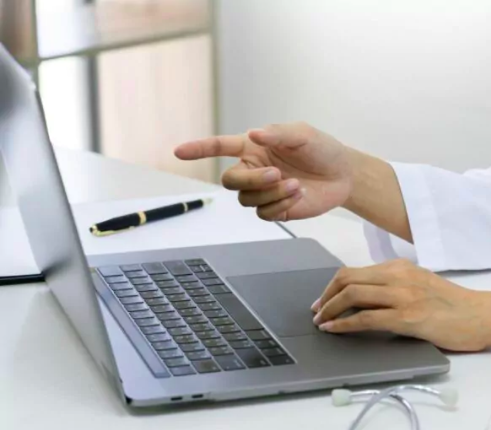
They talk about us




Our commitments

Quality medical care
Since 2019, Feeli's partner doctors, registered with the Ordre des Médecins in France, are trained in teleconsultation. They are committed to guaranteeing optimal quality and continuity of care. Alongside in-person consultations, Feeli helps improve access to healthcare.

Your personal data, secured
Your data is hosted by a provider certified HDS and protected in accordance with the GDPR and French law. All exchanges with the doctor are fully covered by medical confidentiality.

A customer service committed to you
With an average response time under 30 minutes, our support team is available 7 days a week, 10am to 7pm, by phone or email, to assist you and guarantee a smooth, stress-free experience.
Back pain: consult a doctor online for the right treatment
Back pain (lower back and neck pain) is a very common reason for medical consultations. Most of the time, the pain is caused by musculoskeletal problems, particularly affecting the spine. This can therefore involve the bones that make it up (vertebrae), the discs, but also the ligaments and muscles that support it. That said, lower back pain is not always linked to musculoskeletal problems and can have many other causes. The prevalence of back pain also increases with age, affecting more than half of people over the age of 60. In the case of lower back pain, a medical diagnosis is therefore advisable. Easily consult a general practitioner online on Feeli, through teleconsultation.What causes back pain?
Back, lower back or upper back pain is generally caused by conditions affecting the spine and joints. It can also involve the ligaments, muscles and nerve roots surrounding the discs located between the vertebrae. That said, it is often difficult for doctors to identify a single cause. Indeed, many conditions affecting the lower back region can cause a painful stiffening (spasm) of the muscles around the spine. Spasms can also worsen the pain, as can stress or other psychological factors, even though these mechanisms are not clearly understood. Finally, it should be noted that lower back pain sometimes has other causes than musculoskeletal problems, such as gynaecological disorders (premenstrual syndrome, for example), or kidney, urinary and digestive tract conditions (kidney stones, infections of the kidneys, bladder or prostate, diverticulitis, etc.). Conditions affecting the major arteries near the spine can also cause lower back pain. Among the common causes of lower back pain, we can mention:• Osteoarthritis;
• Vertebral compression fractures;
• A ruptured or herniated disc;
• Ligament and muscle injuries;
• Lumbar stenosis;
• Fibromyalgia;
• Or spondylolisthesis.
Injuries can also occur during everyday physical activities, for example when lifting a heavy object or making an awkward movement. Trauma, falls or accidents can also cause lower back pain, even though imaging tests sometimes show no specific injury. Doctors generally assume that muscles and/or ligaments have been damaged. For a diagnosis and to put in place a suitable treatment, easily consult a doctor during an online consultation on Feeli.
Back pain: the different types of lower back pain
Generally, the different types of lower back pain include local, radiating and referred pain. Local pain is the most common type of back pain and can appear in a specific area of the back. This type of pain is generally caused by joint arthritis, a minor disc injury, a muscle strain or a sprain. In the case of an injury, however, the pain can be sudden. In addition, local pain is generally worsened or relieved by changes in position. Finally, the area concerned is generally painful to the touch and muscle spasms may occur. Radiating pain, meanwhile, is characterised by pain travelling down from the back into the legs. This is sometimes referred to as sciatic pain. The pain can also be intense, dull or sharp. Most often, this type of pain appears only on one side or at the back of the leg. It then travels down to the foot or may stop at the knee. Radiating pain can also indicate compression of a nerve root. This compression is sometimes caused by a condition such as a herniated disc, osteoarthritis or spinal canal stenosis. Several actions can also worsen or trigger the pain, such as coughing, or stretching or bending the torso while keeping the legs straight. When the nerve root is compressed, patients generally describe muscle weakness in the leg, with a tingling sensation in addition to the pain. More rarely, some people experience a loss of sensation or urinary or faecal incontinence. Finally, referred pain is characterised by the fact that the painful area is different from the one actually causing the pain. For example, some patients having a heart attack may feel pain in the left arm.Back pain: warning signs to watch for
Certain warning signs should prompt a consultation or teleconsultation. Among the warning signs, symptoms or features that should draw attention in cases of lower back pain, we can mention:• A history of cancer combined with back pain should draw attention;
• Taking immunosuppressant medication, drug injections, HIV infection, recent surgery, a recent injury or other conditions that can increase the risk of infection;
• Weight loss;
• Fever;
• Weakness in the legs, numbness, difficulty fully emptying the bladder (urinary retention), sometimes a loss of bladder or bowel control (urinary and faecal incontinence), or symptoms suggesting nerve compression or damage;
• Severe chest or abdominal pain, a pulsing sensation in the upper abdomen, symptoms possibly caused by an abdominal aortic aneurysm;
• Severe pain at night;
• Vomiting or black or bloody stools, which may suggest digestive disorders;
• Blood in the urine
• Severe cramps on one side radiating towards the flank, blood in the urine, symptoms sometimes linked to urinary disorders.
Treatment for lower back pain
When a specific cause of back pain is diagnosed, it can be treated directly. For example, antibiotics may be prescribed to treat back pain linked to a prostate infection. For musculoskeletal pain caused by strains and sprains, on the other hand, there is no specific treatment. Nevertheless, many general measures can prove useful for relieving back pain, such as:• Stopping or modifying the current activity;
• Taking a pain-relief medication;
• Applying heat or cold to the painful area;
• Continuing to move, as far as possible.
When lower back pain appears suddenly (or is of recent onset), the first-line treatment consists of avoiding any physical activity that could cause strain or pain in the spine. Bending and carrying heavy objects, for example, should be avoided. Most doctors recommend continuing moderate-intensity daily activities alongside this, since bed rest does not speed up recovery. Bed rest should indeed not last more than 1 or 2 days, otherwise the core muscles may weaken and stiffness may increase. As for taking a pain-relief medication, paracetamol is widely used to relieve pain, except in cases of inflammation. In cases of inflammation, non-steroidal anti-inflammatory drugs (NSAIDs) are instead recommended. When NSAIDs and paracetamol prove ineffective, opioid painkillers are sometimes prescribed, for the shortest possible duration.
How can you prevent back pain?
Several general measures can help reduce the risk of developing back pain, such as:• Exercising regularly;
• Doing stretching and muscle-strengthening exercises;
• Standing up straight (maintaining good posture);
• Maintaining a healthy weight;
• Carrying heavy objects using proper technique.
The most effective way to keep a healthy back is to exercise regularly. Muscle-strengthening exercises, stretching and aerobic activities are particularly useful. Swimming, walking or other aerobic activities are therefore recommended, particularly to strengthen muscle tone and improve overall wellbeing. Do not hesitate to consult a doctor without an appointment on Feeli to find an individual treatment strategy.
How is chronic lower back pain treated?
When back pain becomes chronic, other therapeutic measures are needed, such as losing weight. Similarly, when painkillers prove ineffective, doctors may offer other treatments. For example, doctors may use transcutaneous electrical nerve stimulation (TENS) to relieve the pain. The TENS device generates a low oscillating current that produces a slight tingling sensation. This electrical current can sometimes block the transmission of pain signals from the spinal cord to the brain. Depending on the intensity of the pain, the current may be applied several times a day, for a duration of around twenty minutes up to several hours per session. If necessary, a corticosteroid may also be administered, along with a local anaesthetic. This type of epidural injection is particularly effective for treating sciatica caused by lumbar stenosis or a herniated disc. Finally, surgery is sometimes considered, particularly when a herniated disc causes persistent or chronic sciatic pain. Other medical conditions may require surgery, particularly in cases of loss of sensation or loss of bladder and bowel control. Surgeons may perform a discectomy (removal of the protruding part of the disc) or, more rarely, a laminectomy (removal of part of the vertebra).
© 2026 Feeli™ All rights reserved.


